Carbon budget and CO2 balance
The carbon budget specifies the maximum amount of carbon dioxide (CO2) that may be emitted into the atmosphere in order to meet a specific climate target. It is therefore a self-defined variable used to quantify climate targets and prioritize climate measures. The carbon footprint, on the other hand, records the actual greenhouse gas emissions caused by a municipality and can be calculated. IIn order to set the carbon budget for climate protection targets, current CO2 emissions must first be measured. An easy to use method for data collection is helpful here.
Step by step towards a transparent carbon budget for municipalities

In order to establish and review a realistic carbon budget for municipalities, the municipality’s carbon footprint must first be calculated. Tools for data driven urban planning can help here by providing data on actual routes and modes of transport used, for example. This allows scenarios for climate-friendly transport, for example, to be planned in a targeted manner and compared with the carbon budget. It typically covers three areas (scopes) in accordance with the international GHG Protocol standard. The carbon footprint can either be limited to greenhouse gas emissions caused purely by the municipality or be a territorial balance sheet covering all emissions within the urban area.
Three scopes for municipal carbon budgets in climate protection
Scope 1 refers to direct emissions caused by fossil fuels. In municipal climate protection, this would include, for example, CO2 emissions generated by the combustion of fuels in motor vehicles or by heating with gas or oil.
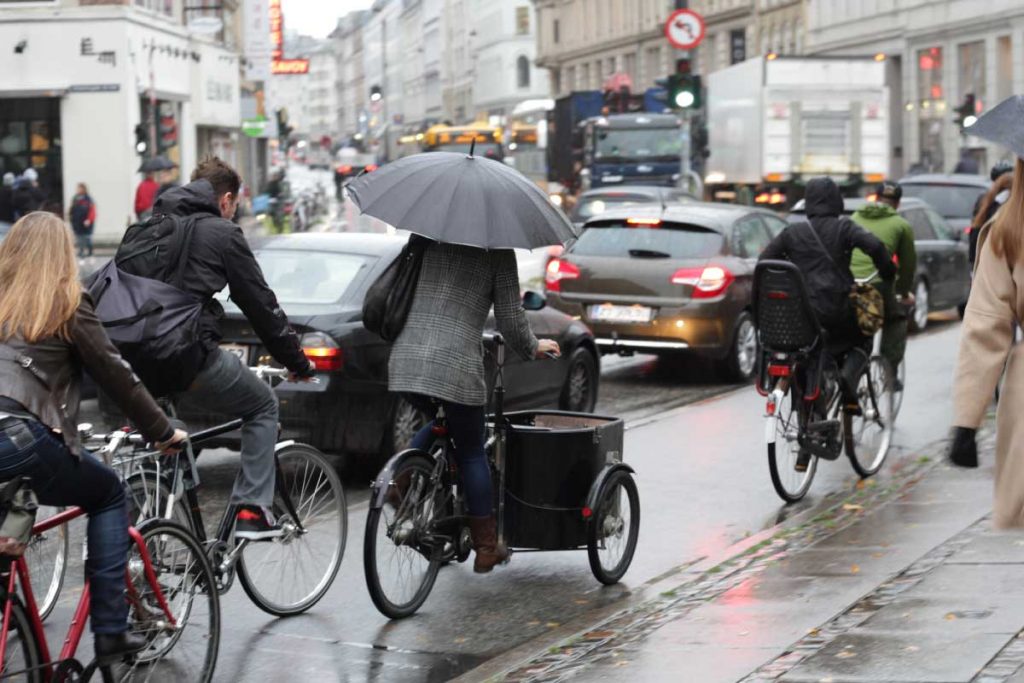
Scope 2 refers to indirect emissions from purchased energy. These emissions are not generated locally, but during the production of energy. In the municipal sector, this would include, for example, electricity for street lighting and, in a broader context, the emissions generated by supplying electricity to citizens.

Scope 3 covers all other indirect emissions that are not caused by energy production. These often account for the largest share and cannot be directly controlled by the municipal administration. Here, the focus is on citizens and their consumption behavior. Motivating them and measuring consumption is therefore a decisive factor in setting and adhering to a municipal carbon budget.

Actively involving citizens
If you do not want to limit your climate targets for the municipality solely to the carbon footprint of emissions caused by the municipality itself, it is important to actively involve citizens. Greenhouse gas emissions generated, for example, by car use, shopping, and heating private households cannot be measured or controlled centrally. However, easy-to-use tools such as the Klima-Taler app make this very simple. This allows a carbon budget to be set that is relevant for the entire municipality and its residents.
The Klima-Taler app makes personal CO2 emissions in municipalities visible to all users. Savings are rewarded with climate coins. Both the visibility and the prospect of collecting valuable climate coins, which can be exchanged for discounts, motivate people to actively support municipal climate goals.

Step by step to a carbon budget for municipalities
- Set the time frame and target for the carbon budget. Germany has set itself the target of reducing CO2 emissions by 65% by 2030 compared to 1990 levels. This target can be applied to municipalities: “Our municipality wants to reduce its emissions by 65% by 2030 compared to 1990 (or 2019, if no older data is available).”
- Create or update the municipal greenhouse gas balance sheet.
- Classify the reduction requirements by sector and develop concrete measures. The emissions budget helps to set priorities.
- Monitoring with various means. The Klima-Taler app takes care of citizens’ private CO2 emissions.
- Check whether the target has been achieved and whether the carbon budget is still up to date. It should be regularly adjusted to the growth of the community and also to new scientific standards.
- Communicate with and involve citizens. Visualizations of CO2 emissions that are easy for everyone to see are helpful here. The Klima-Taler app also helps with practical tools such as the web banner, which makes the collective savings transparent for everyone.
Different methods for calculating the carbon footprint
There are two common methods for calculating the carbon footprint: the territorial balance according to BISKO (Kommunale Energie- und Treibhausgasbilanz) and the consumption-oriented carbon footprint, which focuses on the carbon footprint of each individual. Both methods have their advantages and complement each other very well. We therefore recommend looking into both and, if necessary, using them in combination.
The BISKO method is recommended by the Klima-Bündnis, dem Umweltbundesamt (UBA), and almost all federal states. It maps local municipal energy consumption, i.e., emissions generated within the municipal area. The principle is simple: emissions are calculated from consumption and the emission factor.
The consumption-oriented carbon footprint takes all products and services into account and then calculates per capita consumption data. This method involves the residents of the municipality to a greater extent, but is more complex to implement. A pragmatic solution here is to focus on specific types of consumption and examine them as examples. The Klima-Taler app is helpful in this regard, as it converts every CO2 saving into Klima-Taler, a climate coin, from climate-friendly shopping and green mobility to conscious heating.
While the BISKO method provides more comparable figures, the consumption-oriented CO2 balance sheet, which focuses on the individual, can make the topic of CO2 budgets more tangible for citizens. The two methods therefore complement each other very well.
The carbon budget as a control element for municipal climate protection at a glance
A carbon budget makes municipal climate targets transparent and measurable by specifying how many emissions a municipality is still allowed to emit in order to achieve a specific target. This is based on the CO2 balance sheet. According to the international GHG standard, three emission areas (scopes) are taken into account: direct, indirect, and consumption-related emissions. It is particularly important to involve citizens, as many emissions occur outside the municipality’s direct sphere of influence. Apps such as the Klima-Taler app, which visualize individual savings, can help here.
If you want to use the carbon budget as a control instrument for municipal climate protection, the Klima-Taler app is a helpful tool for actively involving citizens. If you would like to learn more or have specific questions about what you can achieve with the Klima-Taler app in your city, please feel free to contact us!
Markus Schulz