

Planning with a Role Model Effect
A climate neutral administration begins with forward-looking, climate-oriented municipal planning. Every decision — from new buildings and public spaces to infrastructure projects — offers the opportunity to make sustainability visible and to assume a role model function for citizens, businesses, and other administrations.
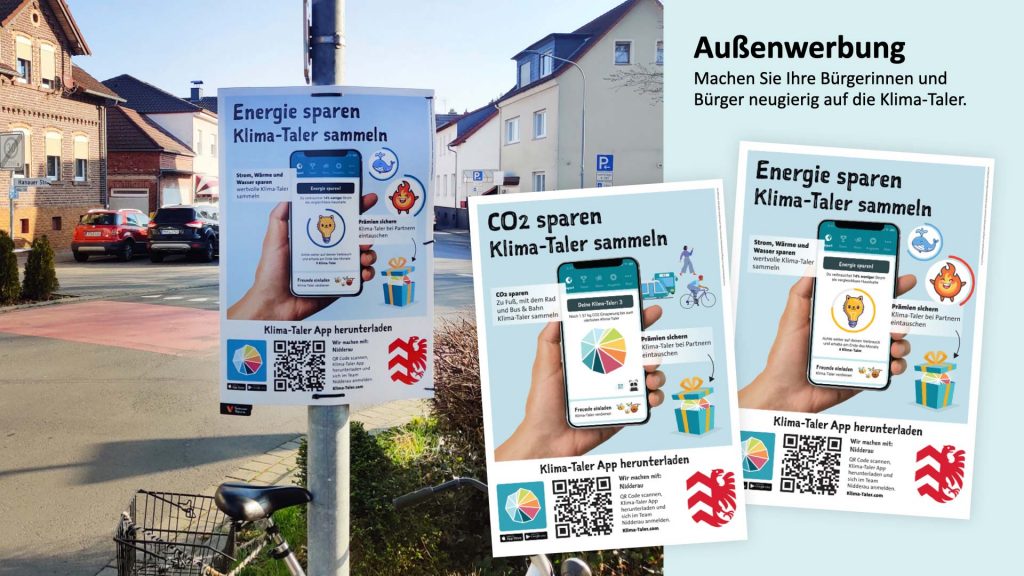
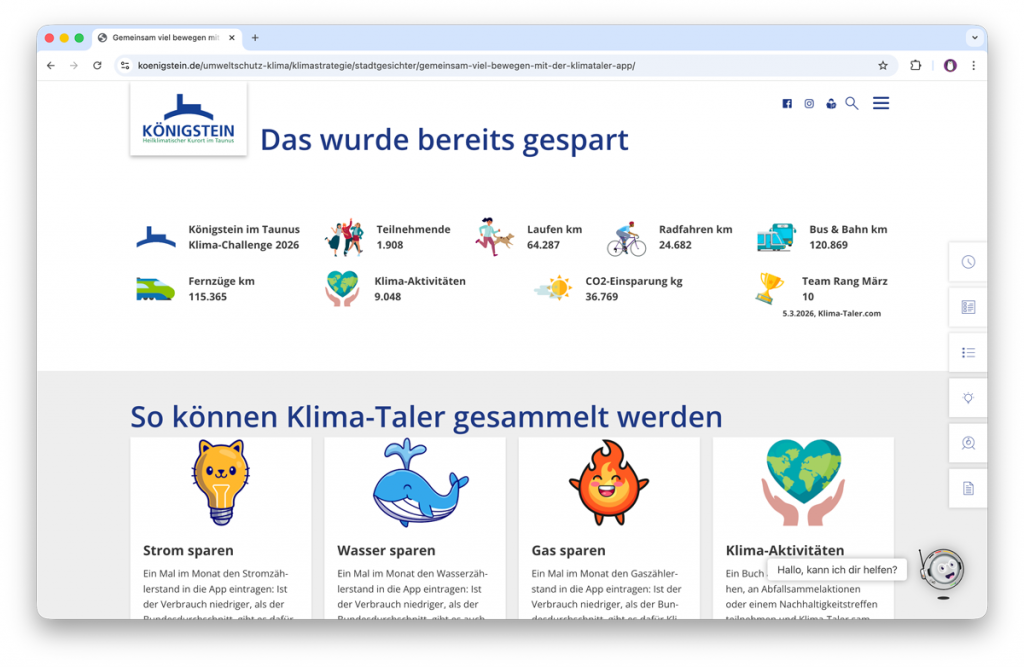
Those who use digital tools such as the Klima-Taler app, which raises citizens’ awareness of municipal climate goals, also gain an advantage in terms of leading by example. The Klima-Taler is accompanied by a public communication campaign. All required materials are available and can be used immediately. Employees, local businesses, and citizens are actively involved. A publicly visible dashboard shows where CO2 savings are successfully achieved. In this way, the municipality becomes visible not only as a planner and decision-maker, but as a living role model that demonstrates sustainable action and supports citizens who actively participate.
8 Measures for a Climate Neutral Administration
A climate neutral municipal administration is achieved through measures implemented simultaneously across several fields of action: buildings, energy, mobility, procurement, organization, and behavior. The decisive factor is not a single measure but a systematic approach with measurable goals.
1. Operating Municipal Buildings in a Climate Neutral Way
Administrative buildings, schools, daycare centers, and sports facilities usually account for the largest share of municipal emissions. A key lever on the path toward a climate neutral administration is the consistent modernization of public buildings.
This includes energy-efficient refurbishment through improved insulation, new windows, and optimized building envelopes, as well as switching heating systems to heat pumps or district heating supplied by renewable sources. Suitable roof areas should also be systematically equipped with photovoltaic systems. Intelligent building management systems with automated heating and ventilation control, together with LED lighting upgrades including motion control, further reduce energy consumption.
Overall, CO2 reductions of 40–60 percent can often be achieved through building-related measures alone.
2. Green Electricity for Municipal Facilities
Another important component of a climate neutral administration is the complete transition of municipal facilities to renewable energy sources. This measure has rapid effects, can be implemented immediately, and is politically visible.
All municipal properties should procure certified green electricity. A municipal photovoltaic initiative with consistent on-site energy use complements this measure. Battery storage systems can increase self-consumption and stabilize renewable energy supply. Municipalities aiming to go one step further can invest in local wind or solar parks, enabling regional renewable energy generation and economic participation.
3. Climate-Friendly Mobility Together
The sustainable design of both official and individual mobility should be part of public responsibilities within a climate-friendly municipal administration. This includes gradually converting the municipal vehicle fleet to electric vehicles and increasing the use of electric service bicycles and cargo bikes.
Expanding charging infrastructure at administrative locations supports climate-friendly mobility, as do new services such as car-sharing solutions or more efficient digital appointment scheduling to reduce travel. Employee mobility also plays an important role: subsidies for public transport tickets, bicycle leasing programs, secure bicycle parking, and parking management systems — for example allowing free parking only for car-sharing vehicles — promote climate-friendly commuting.
With a coherent mobility concept that works for both commuters and employees traveling short distances, the administration visibly fulfills its role model function while permanently reducing emissions.

4. Climate-Friendly Procurement
Public procurement is often an underestimated measure for achieving a climate neutral administration. Purchasing decisions influence energy consumption, resource demand, and CO2 emissions across entire value chains.
Sustainability criteria should therefore be firmly embedded in tenders and procurement procedures. Lifecycle costs should be weighted more strongly than purchase prices alone. Measures include the use of recycled paper and energy-efficient IT equipment, climate-friendly construction materials, and regional and seasonal food offerings in kindergartens, schools, and public administration cafeterias.
Strategically aligned procurement not only reduces emissions but also strengthens sustainable markets and reinforces the public sector’s role model function. How digital urban planning can help with this is explained in a separate article on the topic.+
5. Digitalization as a Driver of the Climate Neutral Administration
Digitalization and modern work organization make an important contribution to emission reduction in everyday administrative operations. Paper-reduced processes, electronic file management systems, and video conferencing help avoid business travel. Remote work arrangements can significantly reduce commuting distances.
Energy-efficient IT infrastructure, sustainable cloud solutions, and automated shutdown functions for workplace devices also help reduce electricity consumption in the long term. By combining digitalization with efficient organization, workflows can be optimized and measures for the climate neutral administration embedded directly into daily practice.

6. Monitoring for Measurable Climate Protection
Systematic energy management forms the foundation of every climate neutral administration. Digital consumption tracking, smart meters, and municipal energy management systems enable real-time monitoring and analysis of electricity, heating, and water consumption.
This data allows CO2 balances to be created, savings potential identified, and concrete climate targets defined for individual departments and buildings. Digital dashboards — such as those offered by the Klima-Taler app — have proven particularly effective for transparency. They can be integrated into existing websites to communicate savings in real time.
7. Engaging Employees in Climate Protection
programs, internal competitions, and climate ambassadors actively involve employees in the transformation process.
The Klima-Taler plays a particularly effective motivational role here. Through gamification elements such as challenges, employees are encouraged to adopt climate-friendly behavior and can see how much CO2 they reduce. Administrative departments can compete in friendly competitions to achieve greater CO2 savings. For saved emissions, participants receive Klima-Taler that can be exchanged for discounts.
This makes monitoring data tangible and action-relevant rather than abstract numbers. Playful recognition increases motivation, builds awareness for decarbonization in everyday work, and demonstrates the direct impact of individual actions.
8. Governance for a Climate Neutral Administration
For climate protection measures to have long-term impact, clear responsibilities and structures are required. Climate neutrality should be secured through binding targets, climate management systems, CO2 budgets for individual departments, and annual progress reports.
How these elements can be integrated into a comprehensive decarbonization strategy is explained in a separate article. The Klima-Taler complements these climate-friendly structures at the operational level by providing data on CO₂ savings, making progress transparent, and creating incentives to actively achieve climate targets.
Involving Citizens
A successful climate neutral administration should actively involve citizens. Many interfaces extend beyond internal process changes and require public acceptance and motivation for successful transformation.
For example, the digitalization of public services must be communicated clearly so that citizens understand that achieving climate goals benefits everyone. The Klima-Taler can again play a key role here. The Klima-Taler app is designed for easy communication with the community and makes CO2 savings tangible.
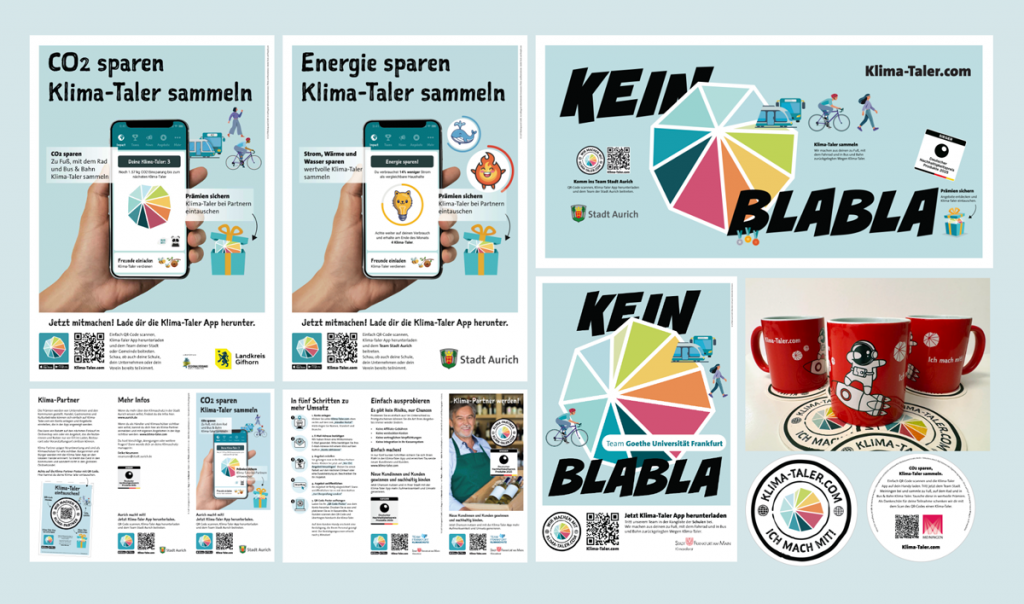
A complete marketing package — including posters, flyers, push notifications, and tools enabling users to invite friends — supports participation. Municipalities that have established the Klima-Taler app can easily take the next step from a climate neutral administration toward a sustainable city, as the app provides current mobility data for digital urban planning.
The Most Important Elements for a Climate Neutral Administration
A climate neutral municipal administration can be achieved through measures in buildings, energy supply, mobility, procurement, digitalization, and governance. Energy-efficient buildings, green electricity, and climate-friendly mobility directly reduce CO2 emissions, while digital processes and strategic procurement conserve resources.
Employees are actively involved and motivated through training and gamification using the Klima-Taler, which makes CO2 savings visible and rewards them. Systematic monitoring ensures transparent CO2 accounting and measurable progress. In this way, the administration assumes a role model function that inspires citizens and local businesses to act in a climate-friendly manner.
If you would like to learn how to use the Klima-Taler on your path toward a climate neutral administration, please feel free to contact us.

Markus Schulz
markus@klima-taler.com